Hey there, fellow electrical folks and anyone who’s ever had to deal with lightning frying their gear—let’s cut to the chase: if you’re working with a T2 120KA Surge Protective Device (SPD) in series, you already know this isn’t your run-of-the-mill outlet surge protector. I’m [your company name here]—and yeah, we’re the supplier for these bad boys—so I’ve seen more than a few install go sideways because someone skipped a tiny, easy-to-miss precaution. Let’s dive into the real stuff, no boring textbook jargon that’ll put you to sleep. T2 120KA Surge Protective Device
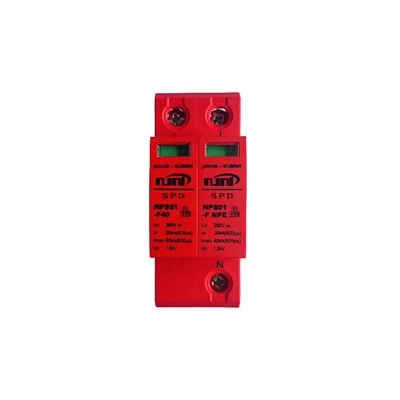
First off, let’s get one thing straight: “series” here doesn’t mean shoving two SPDs in a line like a soda can chain. It means mounting this T2 120KA unit inline on your main distribution panel’s mains, right before it splits off to branch circuits. Why series? Simple—you need high energy handling for big commercial or industrial setups, not just your home’s 15A circuits. But here’s the thing that trips up even seasoned electricians: people mix up series vs parallel SPDs all the time. Parallel is the one that clamps to ground, series is a bit trickier because it’s in the current path, so every tiny misstep impacts its performance.
Let’s start with the big one that most installers ignore until it’s too long: upstream and downstream coordination. Wait, what’s that? Basically, if you put another SPD (say, a lower-rated T1 one at the utility meter) upstream, and your T2 120KA downstream, they can step on each other’s toes. I’ve had a contractor come to me last month saying their T2 kept tripping the main breaker during storms, and it turned out they didn’t calculate the “coordination distance” between the two. The rule here—no guessing allowed—for series SPDs, the upstream (T1) and downstream (T2) need at least 10 feet of straight wire between them, or if you don’t have that, you use a “coordination inductor” (we sell these, fyi, they’re cheap, solve 90% of those issues). Why? Because without that gap or inductor, the two SPDs fight for surge current—like two people pushing a door at the same time—so your T2 can’t dump its 120KA as intended, and instead draws too much current from the mains, tripping the breaker. That’s not just a hassle; if the breaker trips mid-storm, your whole site’s unprotected.
Next up: voltage rating. Duh, right? But hear me out—no one just checks the SPD’s rated voltage. Wait, what’s the nominal system voltage you’re installing this on? If you’ve got a 208Y/120V 3-phase system, that’s line-to-neutral 120, line-to-line 208. Your T2 120KA’s rated continuous operating voltage (Uc) needs to be higher than the maximum steady-state voltage on that line. If you put a Uc=150V unit on a 120V line, wait no—wait, no, if it’s line-to-line 208, you need a Uc for line-line that’s at least 240V. I’ve seen someone slap a generic T2 on a 480V line, and the unit melted in two months because the Uc was only 300V, not the 480V it needed. Series SPDs live in the current path, so they’re under voltage 24/7, not just during surges. If the Uc is too low, it degrades fast—we’re talking 6 months to a year instead of the 10+ years it’s rated for. Don’t cut corners here; pull your panel label, check every line’s steady-state voltage, and match the T2 120KA’s Uc exactly. No “close enough” here.
Then, wiring size and type. This is another one that’s so simple, no one does it right. The T2 120KA series SPD has specific wire gauge requirements—usually, you need 6AWG copper for up to 480V systems, but wait, don’t take my word for it, check the unit’s datasheet. Wait, but why? Because series SPDs carry full load current of the system, not just surge current. If you use 10AWG wire, that’s undersized—you’ll get voltage drop, and the wire itself can overheat, which is a fire hazard. Also, don’t use aluminum wire unless the unit is rated for it. I had a contractor use aluminum wire once, and the connection corroded in a year, creating a high-resistance spot. That resistance made the SPD run hot, and when a surge hit, it couldn’t discharge properly—luckily, he caught it before the unit failed, but that was a close one. Pro tip: torque the wiring lugs to the exact setting in the manual. Too loose, and you get that corrosion; too tight, and you strip the lug. We have a little torque wrench cheat sheet we send to all our installers, just shoot us a message if you need it.
Grounding—wait, series SPD grounding is different from parallel, right? Parallel grounds to the main ground bar, but series SPDs have a separate grounding terminal, and you can’t daisy-chain the ground. The ground wire for your T2 has to be as short as possible (max 2 feet), and it has to go directly to the main grounding electrode conductor (GEC), not a sub-panel ground bar. Why? Because any extra length in the ground wire adds inductance, which slows down the surge current discharge. If the ground is long, the surge can’t get to the earth fast enough, so it bounces back into your equipment—like a water hose kink. I’ve seen a hospital’s server room take a surge hit because their electrician ran the ground 15 feet to a sub-panel, and the T2 couldn’t dump the current. The ground wire size matters too—needs to be at least equal to the line wires going into the series SPD. No 14AWG ground with 6AWG lines. That’s another fail waiting to happen.
Load side considerations—wait, your series T2 is before the branch circuits, so what’s on the load side? You can’t have any other surge protection devices that are parallel type on the load side, right? Wait, no, actually you can, but only if they’re coordinated. But here’s the big one: don’t put nonlinear loads (like VFDs, LED drivers, server power supplies) too close to the T2 without filtering? No, wait, no—actually, nonlinear loads create harmonic distortion, which can raise the steady-state voltage on the lines, putting extra stress on the series SPD. So if your site has a ton of VFDs, you might need to derate the T2 120KA by 20% to account for that harmonic heat. I learned that the hard way when a manufacturing plant with 50 VFDs kept having their T2s fail prematurely. We checked the harmonics, saw they were 25% THD (way higher than the 5% limit), told them to derate, and that fixed the problem. Derating isn’t a fun word, but it’s way cheaper than replacing a $1,500 SPD every 6 months.
Testing before energizing—this is non-negotiable. I don’t care if you’re in a rush to get the power back on, test before you flip the breaker. First, do an insulation resistance test on the series SPD, between line and ground, and line to line. If the insulation is less than 100MΩ, don’t energize it—there’s a short or leak that’ll kill the unit. Then, do a functional test: use a surge tester (not just a multimeter—multimeter can’t catch surge performance) to send a small surge through the unit, and make sure it clamps properly. Last month, an installer forgot to test, flipped the breaker, and the T2 was faulty right out of the box—luckily, he caught it before a storm, but if that was during a thunderstorm, his customer would’ve been furious. Also, after installing, put a label on the unit that says “series T2 120KA, installation date, torque setting, coordination distance” so the next guy working on the panel knows what’s what.
Wait, one last thing: don’t mix and match parts from different brands. I know it’s tempting to save a buck, but if you buy our T2 120KA, don’t pair it with a random brand of coordination inductor or a random ground lug. We test every part of our SPDs with our matching accessories, so if you use a third-party part, you’re risking the coordination we built into the unit. I had a guy use a cheap inductor from another brand, and his T2 couldn’t discharge the surge during a storm, taking out three air conditioning units. He came back apologizing, and we gave him a replacement SPD, but that was a $20,000 mistake he could’ve avoided by using the right parts.
Look, I get it—installing an SPD isn’t the most exciting part of electrical work. But when you’re dealing with a T2 120KA, which is meant for big, expensive setups (commercial buildings, manufacturing plants, data centers), cutting corners on installation precautions doesn’t just mean a broken SPD—it means downtime, damaged equipment, and mad customers. We’re not just a supplier—we’re here to help. If you’ve got questions about coordination, wiring, Uc ratings, whatever, just reach out to us for procurement and technical guidance. We’re not the type to sell you a unit and ghost you when you run into issues—we’ve got installers on our team that can walk you through every step, no charge, no sales pitch.
Now, before you go back to the job site, double-check that coordination distance, that ground wire is short, that the wire gauge is right, and that you tested before energizing. Those four steps alone will save you 90% of the headaches I mentioned today. Surges aren’t going away—they’re getting worse with all the electronics we use—so making sure your T2 120KA is installed right is the best way to protect your work (and your customer’s wallet) from the next big storm.
Wait, one quick recap I should have led with: series vs parallel. Parallel is for end-of-line, small loads, clamps to ground. Series is for main distribution, inline, handles high current, needs all the precautions I talked about. Don’t mix them up. Trust me, I’ve seen someone try to wire a series SPD like parallel, and the unit exploded when they turned on the power. That’s the kind of story I tell at trade shows to make people listen.

So, if you’re ready to grab the right T2 120KA for your next job, or you’ve got questions about installing one, hit us up for procurement discussions. We’re here to make this stuff easy, not stressful. No jargon, no runaround, just real advice from a supplier that’s been in the game long enough to know what goes wrong when you skip the small stuff.
Surge Protection Device References
- IEEE Std. 1100-2020, IEEE Recommended Practice for Powering and Grounding Electronic Equipment
- NEC Article 285, Surge Protective Devices
- UL 1449, Standard for Safety for Surge Protective Devices
Nanjing Ningpu Lightning Protection Equipment Manufacturing Co., Ltd.
Address: Building 1, No.20 Shengyuan Road, Lishui Economic Development Zone, Nanjing City, Jiangsu Province, China
E-mail: 3796023563@qq.com
WebSite: https://www.npspd.com/
